Loss of a Pet: How to Manage Grief
Η loss of a pet can abruptly change our daily lives. Anyone who has truly loved a dog or cat knows that they are not losing «just an animal.» They are losing a presence in the home, a character, a daily habit, and a companion who participated in small and big moments of life.
This is why grieving after the death of a dog or cat can become deep and very personal. Some people need time, others want to talk about their pet, and still others are looking for a way to keep their memory alive.
In this article we will see why it hurts so much loss of a pet, how we can manage grief, what we do with the animal's personal belongings and in what ways we can honor its memory.
Why does losing a pet hurt so much?;
Why do we form such a strong bond with a dog or a cat?;
Pets participate in our daily lives in a way that we often only fully realize when they are gone.
The dog waits for us to come home. The cat chooses its favorite spot near us. We know when they want food, a toy, or just our presence.
Over time, these small moments create a strong emotional bond.
When a pet dies, we also lose an important part of our daily routine. So, the house can suddenly look different and the absence can be especially felt.
Is it normal to grieve intensely for a pet?;
Is there a right or wrong way to experience grief?;
No.
Every person experiences it differently. loss of a pet.
It may feel:
- deep sadness,
- anger,
- loneliness,
- guilt,
- nostalgia,
- difficulty concentrating,
- changes in sleep,
- decreased appetite,
- strong need to talk about the animal.
Furthermore, emotions can change from day to day.
Someone may be feeling better and, suddenly, a photo, a toy, or the sound of a leash brings back the sadness.
This does not mean we «go back.» Grief does not always follow a straight path.
How long does grief last after losing a pet?;
Do we have to "get over" the loss at some point?;
There is no specific time limit.
Some people begin to adapt to their new routine within a relatively short period of time. Others need much more time.
For this reason, it doesn't help to compare our own grief with someone else's experience.
The bond with each pet was different. Therefore, the process of loss will be different as well.
The important thing is not to force ourselves to «forget.» Instead, we need to gradually find a way to move on with our lives while preserving the beautiful memories.
What do we do with a pet's belongings after its death?;
Should we immediately pack up the bed, bowls, and toys?;
No.
There is no reason to rush.
Some people want to quickly remove objects because they cause them intense sadness. Others want to keep them in place for a long time.
Do what helps you the most.
You can also choose a few items that have special significance, such as:
- the collar,
- the identity,
- a favorite game,
- a blanket,
- a photo,
- a footprint.
You don't have to keep everything. Keep the ones that are truly connected to beautiful memories.
How do we talk to children about losing a pet?;
Should we hide from them what happened?;
Honesty, in words appropriate for the child's age, usually helps more than vague or complicated explanations.
Children may ask many questions.
Listen to them and answer as simply as you can.
At the same time, allow the child to express his sadness in his own way.
It can:
- draw his favorite animal,
- write a short letter,
- choose a photo,
- make an album,
- participate in the creation of a memory corner.
We also don't always have to hide our own emotions. We can show children that sadness is a natural reaction when we lose someone we love.
Do the other pets in the house also mourn?;
Can a second dog or cat sense absence?;
Many guardians notice changes in the other animal's behavior after the death of a pet.
For example, it may:
- is looking for his partner,
- sleeps more,
- seeks more human contact,
- eats less,
- looks anxious,
- changes his daily habits.
However, we should not automatically attribute every change to grief.
If the animal stops eating, loses weight, or exhibits a significant change in health and behavior, we contact the veterinarian.
At the same time, it helps to maintain the usual daily routine as much as possible.
How can we keep the pet's memory alive?;
Do we need to create a big monument?;
No.
Memory can take very simple and personal forms.
For example, you can:
- Create a photo album.
- Keep his collar or ID.
- Plant a tree or a flower.
- Write a letter with your favorite memories.
- Create a portrait.
- Make a donation to an animal welfare organization.
- Create a memory box.
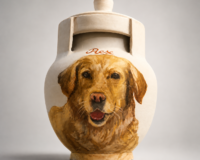
- Keep the ashes in a pet urn.
- Create a small memory corner at home.
The important thing is to choose something that connects to your own relationship.
Can a pet urn be part of a memorial?;
Why do some people choose to keep the ashes?;
After the loss of a pet, many guardians choose private cremation and keep their dog or cat's ashes.
In this case, the urn may have a purely practical purpose.
However, it can also function as a personal keepsake.
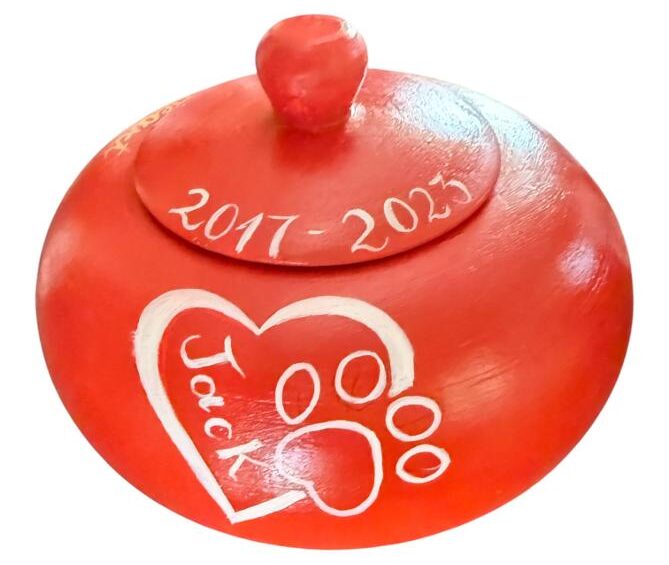
An urn may include:
- the pet's name,
- dates,
- a small dedication,
- his portrait,
- a footprint,
- colors associated with the animal.
So, we're not just choosing a place for the ashes. We're creating an object that's connected to a specific story.
How do we create a beautiful memory corner at home?;
What can we put there?;
You don't need many items.
Choose, for example:
- a favorite photo,
- the collar,
- a small personal item,
- the urn,
- a discreet light fixture or a plant.
Keep the composition simple.
This way, you create a spot that is reminiscent of the pet's life without making the space heavy.
Should we get another pet right away?;
Can a new animal fill the void?;
We don't need to treat a new pet as a replacement.
Each animal creates a different relationship.
Some people may feel ready for a new pet relatively quickly. Others may need months or even longer.
Both choices are personal.
The new animal does not erase the memory of the previous one. It simply creates a new story.
When do we need to seek help for grief?;
When does sadness begin to significantly affect our daily lives?;
If the loss of a pet If it is affecting our sleep, work, relationships, or ability to function on a daily basis for a long time, it is worth seeking support.
We can talk to:
- a person we trust,
- a mental health professional,
- a pet loss support group.
Talking about the animal and how we feel can be an important part of adjusting to its absence.
Conclusion: Losing a pet does not erase the relationship we created
Η loss of a pet leaves a real void.
However, over time the way we remember can change.
At first, we may keep going back to that last difficult day. But later, we start to remember again the walks, the games, the funny habits, and all those little moments that made our pet unique.
We don't need to forget to move on.
We can hold on to the memory without holding on to only the sadness.
Because ultimately, it's not just worth remembering how an animal passed away. It's worth remembering mainly how it lived with us.
We don't just remember how they left. We mainly remember how they lived alongside us.



 In closing, remember…