We avoid words that bring us closer to the most difficult truth of life. We avoid talking about loss. "Cream" belongs to these words.
But it does not hide coldness. It expresses a deep human need: to give meaning to farewell.
We choose, we are not afraid
Today, in Greece, we do not treat cremation as taboo. We choose it more and more often.
We are changing our lifestyle. We are moving. We live in different cities, different countries. Within this new reality, we are looking for solutions that allow us to keep our people close.
We don't avoid the decision. We make it consciously.
We transform memory into presence
We do not treat the urn as an object; we transform it into a point of memory.
We hold the person we loved close to us. We create a personal space of connection. We choose where and how we honor them.
We don't just follow formal procedures; we give meaning.
After all, as popular wisdom says, "a person lives as long as you remember him.". And we choose to actively remember.
We respect without conflict
The Orthodox Church supports burial as an act of faith and tradition. The State, with Law 3448/2006 and subsequent regulations, establishes cremation as an option.
Cremation of the dead in Greece is no longer a "distant" option and is becoming established as a reality that is constantly gaining ground. The value of life does not change; on the contrary, the way we manage it is transformed until the end of it.
At the same time, the word "urn"« is heard more and more often and, at the same time, it opens a dialogue that we have been avoiding for years. Simply put, The time has come to answer questions that we all have, but few dare to ask..
Is cremation legal in Greece?;
The Greek state has explicitly allowed cremation for years and now organizes crematoriums that serve citizens.
However, there is a crucial condition: the wish must be clearly stated.
Either the person himself declares it while he is alive
Whether his relatives express it after his death
In other words, the right exists — but the decision remains deeply personal.
How is the cremation process carried out?;
Contrary to popular beliefs, the process progresses simply, organized and without unnecessary hassle.
Specifically:
The necessary documents are issued
The body is being transported to the crematorium.
Cremation is carried out (duration approximately 2 hours)
The urn is delivered to the relatives
Then, relatives choose:
Home storage
Placement in a special place
Scattering of ashes (where permitted, such as at sea)
So, the process takes on a quieter and simpler character — as if one were to remove the superfluous and keep the essence.
The child does not always express strong emotions. He continues playing, appears calm, or withdraws.
With this attitude he tries to deal with the loss. He doesn't avoid the pain; he just hasn't found a way to express it yet. He keeps what he feels inside until he can express it.
The fear that arises after loss
How does the sense of security change?;
The child loses a sense of stability when they lose a parent. They don't just lose a person; they lose the foundation that gives them security.
He is afraid. He wonders if he will lose the other parent, if he will remain safe, and if he can trust the world around him. Even when he does not express these thoughts, he carries them inside and changes his behavior.
Anger as an expression of pain
Why is the child reacting strongly?;
The child expresses his pain through anger. He reacts, shouts, moves away or questions those around him.
He's not trying to provoke. He's trying to endure. Anger acts as an outlet for the tension he can't handle otherwise. Behind every reaction lies deep sadness.
The guilt that weighs silently
Can the child feel responsible?;
The child often associates the loss with himself. He believes that he did something wrong or that he could have prevented what happened.
In this way, he tries to explain something he doesn't understand. For this, he needs to hear clearly and repeatedly that he bears no responsibility.
The sadness that comes and goes
Why does his mood change so quickly?;
The child does not remain in sadness all the time. He goes from playing to crying and back again.
With this alternation, he protects himself. He doesn't forget the loss; he simply regulates the intensity of the pain so that he can manage it.
Absence in everyday moments
When does the loss become more intense?;
The child feels the absence most intensely in the simple moments of everyday life. He wants to talk and can't find the parent. He wants to share a joy and can't.
In these moments, he understands loss again. He feels the emptiness and pain more intensely.
How can we support a grieving child?
What does he really need?;
The child needs presence, honesty and acceptance. He needs an adult who listens to him without pressuring him and gives him space to express what he feels.
The adult tells the truth in simple words, answers questions, and remains steadfast by his side. At the same time, he accepts every emotion without correcting or diminishing it.
In this way, the child feels safe. Within this safety, he gradually finds his own way to process the loss.
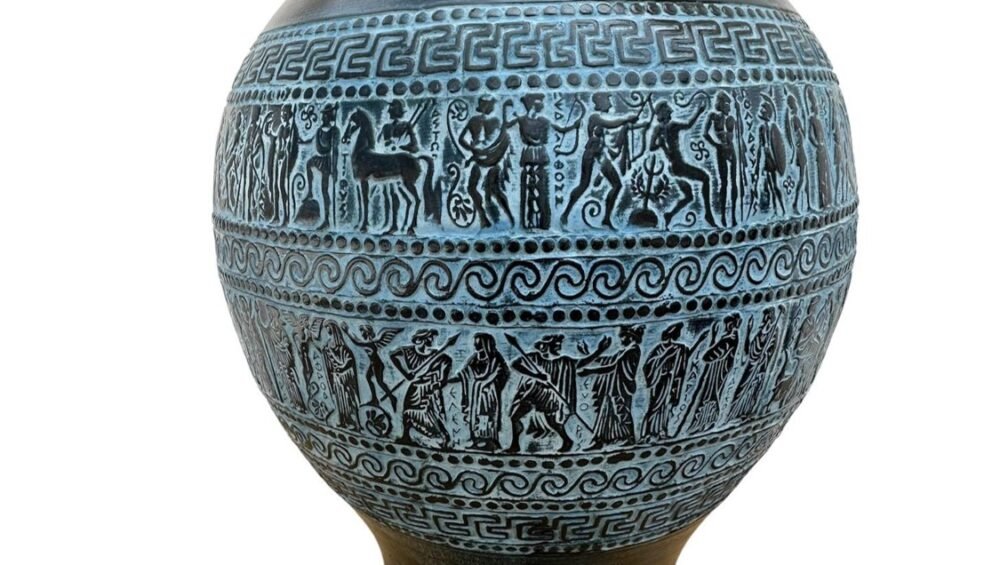
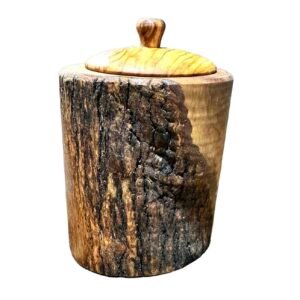
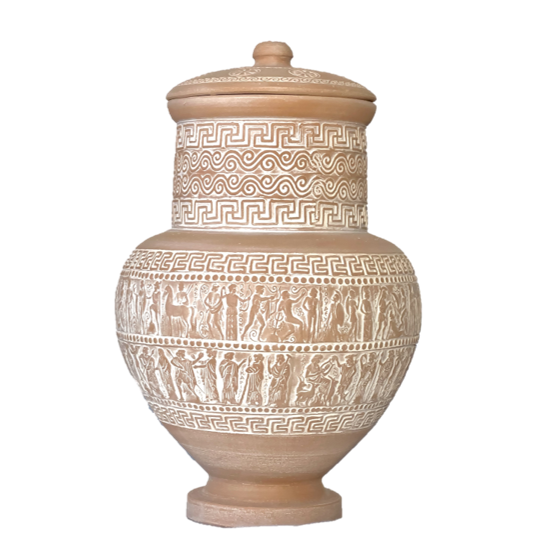
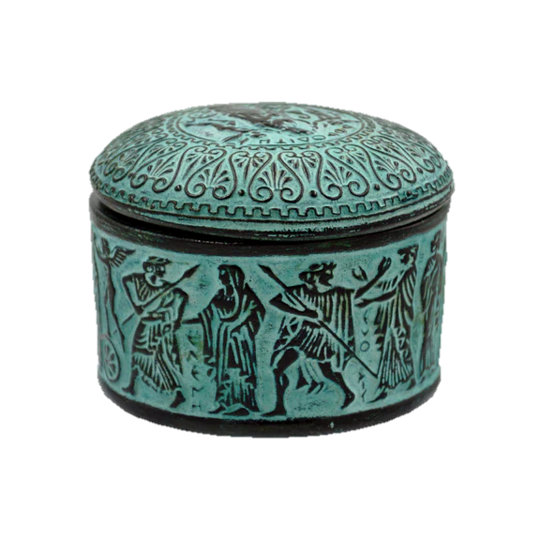
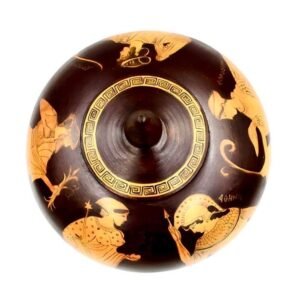
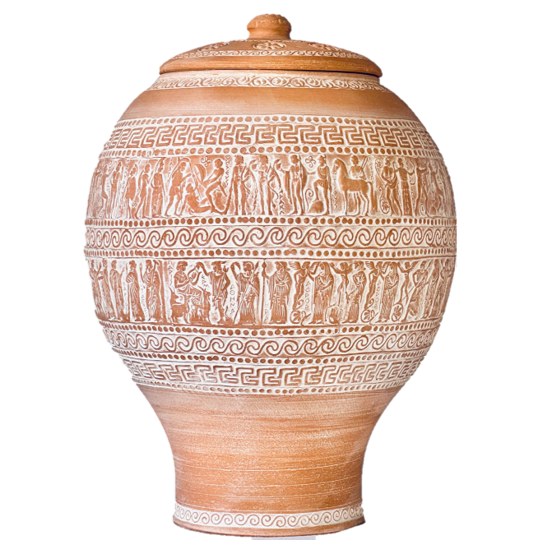
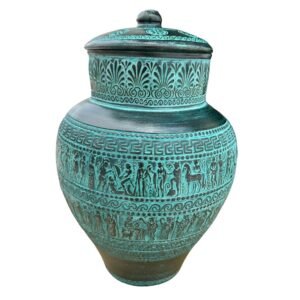
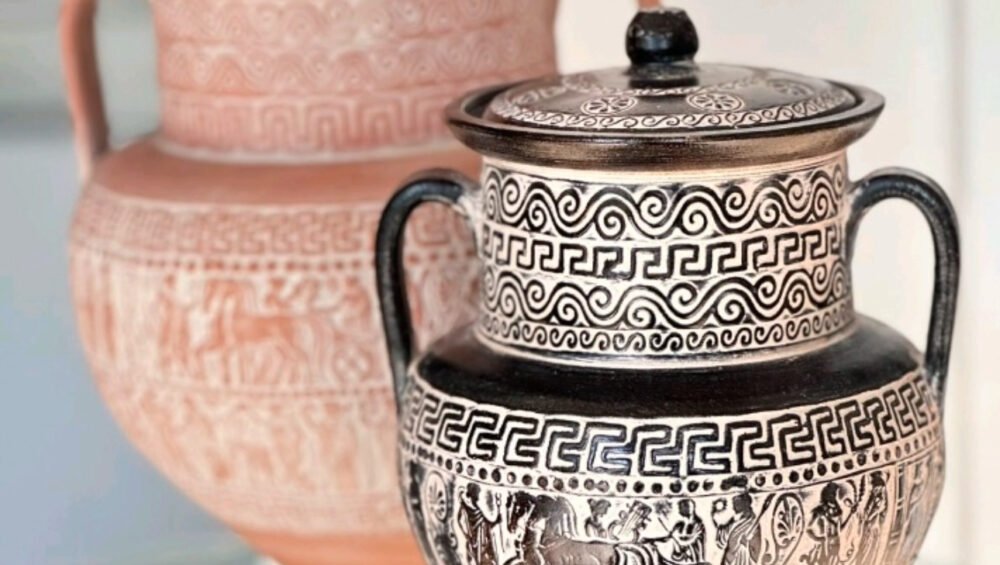
The handmade ones urns they are not production line products.
Craftsmen create each urn with knowledge and experience that have been passed down from generation to generation for centuries. They work with wisdom, passion and love, and take care of each handmade urn individually.
Each urn
presents small variations, because it remains unique in the world
bears the imprint of the creator and the seal of handmade
It is always different from any other, because the craftsman makes it one by one by hand, 14 times!
This means something simple but profound:
Each urn stands out. And its material conveys a unique, living energy to accommodate the person you loved.
Ceramic urns in Greece – a centuries-old tradition
Greece has a deep connection with pottery. From ancient times to the present day, people have cultivated the art of ceramics and associated it with their cultural identity.
Craftsmen today continue this path.
Ceramic urns:
combine durability and aesthetics
maintain traditional techniques
exude timelessness and the natural energy of the material
They are not just objects. They continue a living tradition.
As we say: «"Whatever we make with our hands, we keep in our hearts.".
Advantages of handmade urns
When you choose a handmade urn, you are not just choosing aesthetics. You are making room for memory, love, and nostalgia.
The main advantages:✔ Offers high quality construction✔ Withstands time✔ Stands out with a unique design✔ Conveys strong emotional value✔ Acquires the value of a work of art
Unlike mass-produced products, here the creator takes care of every detail. He processes the urn up to 14 times by hand until it reaches its final form.
Why quality matters in choice
When you're looking for an urn, you often think about the price. It's natural.
But quality determines real value.
A quality ceramic urn:
preserved in time
does not deteriorate
offers aesthetic harmony
And above all: it gives you the certainty that you are honoring the person hosting you.
How to choose a handmade urn
You don't follow rules. You listen to yourself.
However, you can focus on key points:
Material (ceramics offer timelessness)
Design (simple or symbolic)
Build quality
Feeling that creates you
If something brings you peace, that's what drives you.
The emotional dimension of choice
Here lies the essence.
You don't choose an urn based on technical criteria. You choose with your heart.
You make a silent decision that you don't easily explain.
As we say: «"Important choices are not explained; we feel them.".
Frequently asked questions
Why choose a handmade urn?; Because it holds a unique character and greater sentimental value.
Do ceramic urns last?; Yes, when craftsmen build them correctly, they stand the test of time.
Are there handmade urns in Greece?; Yes, and they are among the most authentic choices, as in topurns.com.
Handmade urns are not just a choice. They are a way of life.
You show that you do not treat memory as something formal, but as something living.
Because in the end: the value is not hidden in the object. You create it, through the meaning you give it, hosting the soul you loved.